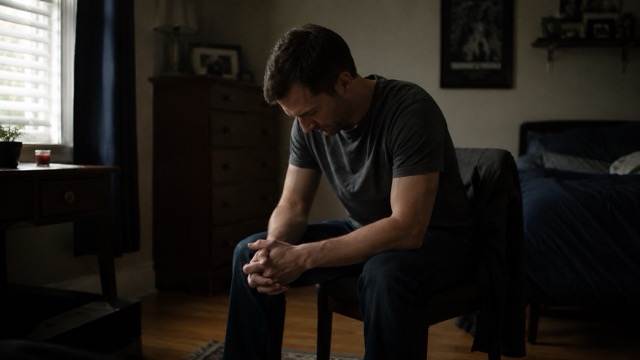
This is the most common ED story in men under 50. A single underwhelming sexual experience, often with no specific cause, gets stored in memory. The next time, the worry that it might happen again is enough to make it happen again. By the third or fourth time, the man is not having sex with a partner. He is having sex with the fear of the previous time.
This is performance anxiety. It is a self reinforcing loop, and once it is going it does not respond to willpower. It does respond to two specific interventions.
The Mechanics Of The Loop
An erection needs the parasympathetic nervous system. Rest and digest. Relaxation. Anxiety activates the sympathetic nervous system. Fight or flight. Sympathetic activation directly suppresses erection because it constricts the relevant blood vessels.
So a man who is anxious about losing his erection is physiologically preventing the erection. The anxiety is the cause. Not a personality issue, not weakness, just biology. Knowing this changes how you treat it.
Why Willpower Does Not Work
Trying harder makes it worse. Concentration is sympathetic activation. The act of focusing on producing an erection is the opposite of what produces erections. Men who push through with effort usually report it gets worse, not better.
This is why advice like 'just relax' from a partner, while well meaning, does not help. The man cannot decide to relax. He needs the loop broken in a way that bypasses his conscious effort.
The Two Things That Break The Loop
1. Removing the failure possibility
If a man knows, with certainty, that he will be able to get an erection, the anxiety has nothing to feed on. The most reliable way to produce that certainty is medication for a short period. A few successful experiences in a row, reliably, breaks the conditioning. The brain stops anticipating failure because failure stopped happening.
This is why a short course of PDE5 inhibitors is often the most effective intervention for performance anxiety ED, even though the original issue is psychological. The medication treats the symptom, the symptom not happening treats the cause.
Many men taper off the medication after a few weeks or months as confidence rebuilds.
2. Shifting attention away from performance
Sensate focus is the classic therapy technique. Couples agree to a period of physical intimacy without intercourse, focusing on touch and sensation rather than goal directed sex. It removes the performance frame entirely. Over time, intercourse is reintroduced with the anxiety component reduced.
Most men do not need formal therapy to use the principle. Choosing some encounters where intercourse is explicitly off the table, doing what feels good, ending without sex, can break a cycle remarkably quickly. The relief of not having to perform allows the body to respond naturally.
What Makes It Worse
- Avoiding sex entirely. Reinforces the avoidance.
- Drinking before sex 'to relax'. Acute alcohol blunts erection. Reinforces the failure pattern.
- Researching ED obsessively. Reading about it during the day keeps the cognitive loop active.
- Not telling the partner. The pressure to hide the issue is itself a form of performance anxiety.
What Makes It Better
- Naming it. To yourself, then to your partner. The internal narrative loses some power once it is spoken.
- A short course of medication to break the conditioning.
- Sensate focus or its informal equivalent.
- Cardio exercise. Not directly related but lowers baseline anxiety, which lowers reactivity in the moment.
- Sleep. Sleep debt makes anxiety worse.
- If the cycle is well established or there are other anxiety issues, brief CBT can be very effective.
How Long Does It Take
For men who address it actively, the loop often breaks within four to eight weeks. The medication contributes the early wins. The lifestyle and cognitive shifts make the change durable. By six months, most men can have sex without the medication or with it as a backup for occasional use.
The trap is doing nothing and waiting for it to resolve on its own. It does not, usually. Performance anxiety is one of the conditions where active treatment changes the timeline by months or years.
Want To Talk To A Doctor
Online consultations through Online Doctor SA are private, quick, and take around ten minutes.
Start Consultation